Capturing Our Conscience the Art of Photojournalism by Stephen Henkins
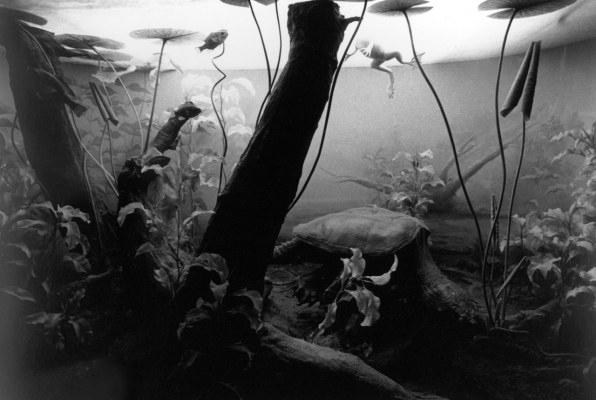
When Diane Fox, a photographer and blueprint professor at the University of Tennessee, took her first diorama landscape photo, she had intended for it to turn out kitschy. Information technology was 1998, Fox was shooting in black and white film at the Natural History Museum in Ann Arbor, Michigan, and she wanted to capture a fake frog floating atop fake water in the midst of a especially ill-constructed underwater pond scene. "It all looked very plastic, which is non typical of dioramas," she says. "I took a film considering I thought information technology was going to exist funny."
When she developed her flick, though, the plastic scene appeared strangely beautiful. Without colour, the shallow depth of field made the painted background looked like an bodily habitat; the manmade wildlife looked alive. The besides-bright museum lightbulb hanging above the diorama gave the underwater scene an eerie glow. That dreamlike blurring of real and unreal, living and merely pretending to be, became the ground for Fox's nearly decade-long ongoing serial UnNatural History.
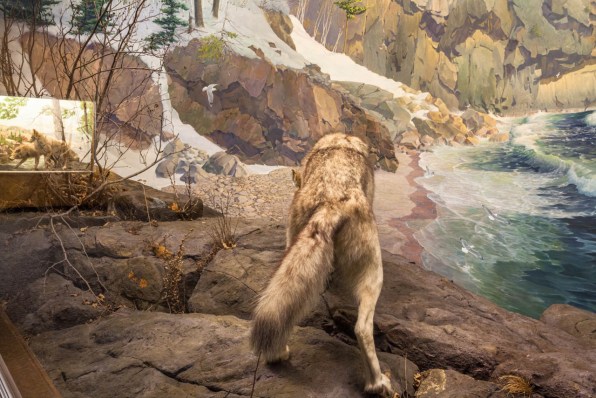
Since that first photograph in Michigan, Fox has visited well-nigh 30 museums and galleries—most of them museums of natural history—in cities across the U.South. and in Europe. She has photographed roaming buffalo in Bremen, Germany, at the Ubersee-Museum Bremen, and lanky giraffe at the Smithsonian Museum of Natural History in Washington D.C. Most recently, she's also expanded her work to include surreal portraits of taxidermy animals against a bare backdrop, staring squarely at the camera as if taking a school photo.
At first, Fox fit in museum visits whenever she traveled for work or vacation, but lately academy funding has immune her to travel to cities solely for the purpose of visiting natural history museums for her series. Her photos—which she takes inconspicuously, like just another museum visitor—have also evolved. In one case shot in film and black and white, her photos are now digital and in color, and she prints them off in massive sizes.
What remains consistent throughout all of the photos in the series is the subtle infringement of the built surroundings on the scenes depicting wild fauna and nature. Dissimilar the unassuming photos of photographer Hiroshi Sugimoto, who also works in dioramas, Fox'due south images always hint at the fact that the scenes are constructions, fifty-fifty when the flatness of the photo makes the scene look real. In several images, the museum can be glimpsed through a reflection in the glass. In others, ceiling lights disrupt the placid nature scenes, or a break in the glass panes distorts a Saharan habitat.
"I was interested in pointing out the falseness of what we were seeing before the states," says Fox. She hopes that viewers will approach the photographs thinking the scene is real, then experience a shift in perception when noticing the other elements. "Fine art is most interesting if you proceed going back to it and it's dissimilar every fourth dimension," she says.
Fox teaches graphic design courses at the University of Tennessee's college of compages and design, where she also used to teach a course in architectural photography. She says her design background ever comes into play in her photography piece of work, virtually notably when she'southward creating compositions. She does all of her work in-camera—she doesn't change the images in photoshop in post-production. "I definitely feel that having a designer'southward eye that connects to composition, whatever type of limerick that may exist," she says.
In 2006, while shooting at the Milwaukee Public Museum, in Wisconsin, she decided to switch to color photography after finding a scene of antelope that were withal wrapped in plastic subsequently existence moved into place. The contrast of the landscape and the dusty tarps looked more vivid and uncanny in color. Since then, her more than recent digital color photos accept fabricated the line between real and imitation somewhat sharper than when she outset started out. Ultimately, Flim-flam hopes that past making the separation betwixt man and nature so visible in these bizarre scenes, people will think virtually why the museums demand to construct the dioramas in the beginning identify.
"The reality of those lives and the way that we've mistreated animals and taken abroad their habitats is that some of those animals are already extinct," says Play a joke on. "The but fashion nosotros are going to run into them now is in a natural history museum."
Source: https://www.fastcompany.com/3068539/the-fine-art-of-capturing-manmade-wildlife

Post a Comment for "Capturing Our Conscience the Art of Photojournalism by Stephen Henkins"